

Merch is Media
Dua Lipa's Il Pellicano hat and why retail is the channel for the experience economy

If you’re just joining, this article is part 3 of a 4-installment mini series on the ascent of hospitality merch. Catch up below before reading on:
Today we arrive at my favorite topic in this series: the evolution of merch into an entirely new channel within a hotelier’s media ecosystem.
Of course, merch and media have co-existed in hospitality for decades, but they only ever crossed in one direction: media advertised the merchandise. What’s new is the product becoming the media vehicle itself.
Two forces made that possible. The post-pandemic ascent of the experience economy, and the parallel cementing of social media as the ultimate stage for status. The result is feeds inundated with people performing their participation in that economy. We’ve all voyeuristically watched someone else’s glam vacation, and we’ve all felt our own posting shift into overdrive the moment the OOO message goes up. Merch extends that logic. It lets you signal your taste, your sensibility, your belonging and your access 52 weeks a year instead of one or two.
Smart marketers, certainly at the big brand level, are catching on and treating hotel merchandise as an explicit media strategy rather than an ancillary revenue stream. Merch has become the physical anchor of the experience economy. Call it ResortCore if you like a label. What it actually does is turn a lifestyle object, a hat, a tote, a robe, into a broadcast channel with no media spend attached. Instead of buying impressions that evaporate the second the budget stops, a hotel turns its guests into walking distribution. The brand leaves the property and keeps working long after checkout.
A Market Bigger Than The Property
A hotel’s addressable market used to be capped by room count and occupancy. That ceiling no longer applies to the hotel’s brand.
Guests aren’t just buying a room anymore. They’re buying a version of themselves they want to become, and merch is how that identity travels beyond hotel walls, or gets imagined by someone who’s never checked in at all. Beyond the on-property retail outlets, an e-commerce storefront breaks the physical boundary of the property entirely. It monetizes the guests, and it monetizes the people who may never book a night but want the aesthetic or the recognition. The product is no longer finite in the way the room count is.
In a previous articles, we covered a few brands that have done this well: Aman Essentials, and Pellicano Hotels’ ISSIMO, Sense of Lake, just to to name a few. Resort wear, artisan collaborations, custom-formulated skincare, sold with the same discipline as a premium digital-native vertical brand or a niche style publication. The storefront functions as a top-of-funnel discovery engine, keeping the brand visually and culturally relevant 365 days a year, independent of occupancy, seasonality or RevPAR.
The Fourth Category
Media has traditionally been categorized in three ways: owned (social, email, SEO), earned (press, word of mouth, anything you don't pay for or control), and paid (billboards, social ads). Merchandise doesn't fit neatly into any of them. It's sold like a product, but it behaves like the earned media category, generating word of mouth, content and data, except a hotel doesn't have to hope for it or wait for a journalist to write it up. The guest buys the distribution directly. Done well, merch keeps paying: in word of mouth, in content, in data, long after the initial sale.
There is, of course, an initial investment required to design and produce the product. But the guest is the one making the purchase, which means the return starts immediately, before the additional accelerators (word of mouth, content, or data) ever enter the picture.
Word of mouth moves first, and nothing outperforms it for credibility and stickiness. A branded object worn in public carries more trust than any paid placement, because it isn’t a placement. It’s a choice. Add the IYKYK layer, the quiet signal to anyone who recognizes the reference, and you have the highest-credentialed billboard in marketing.
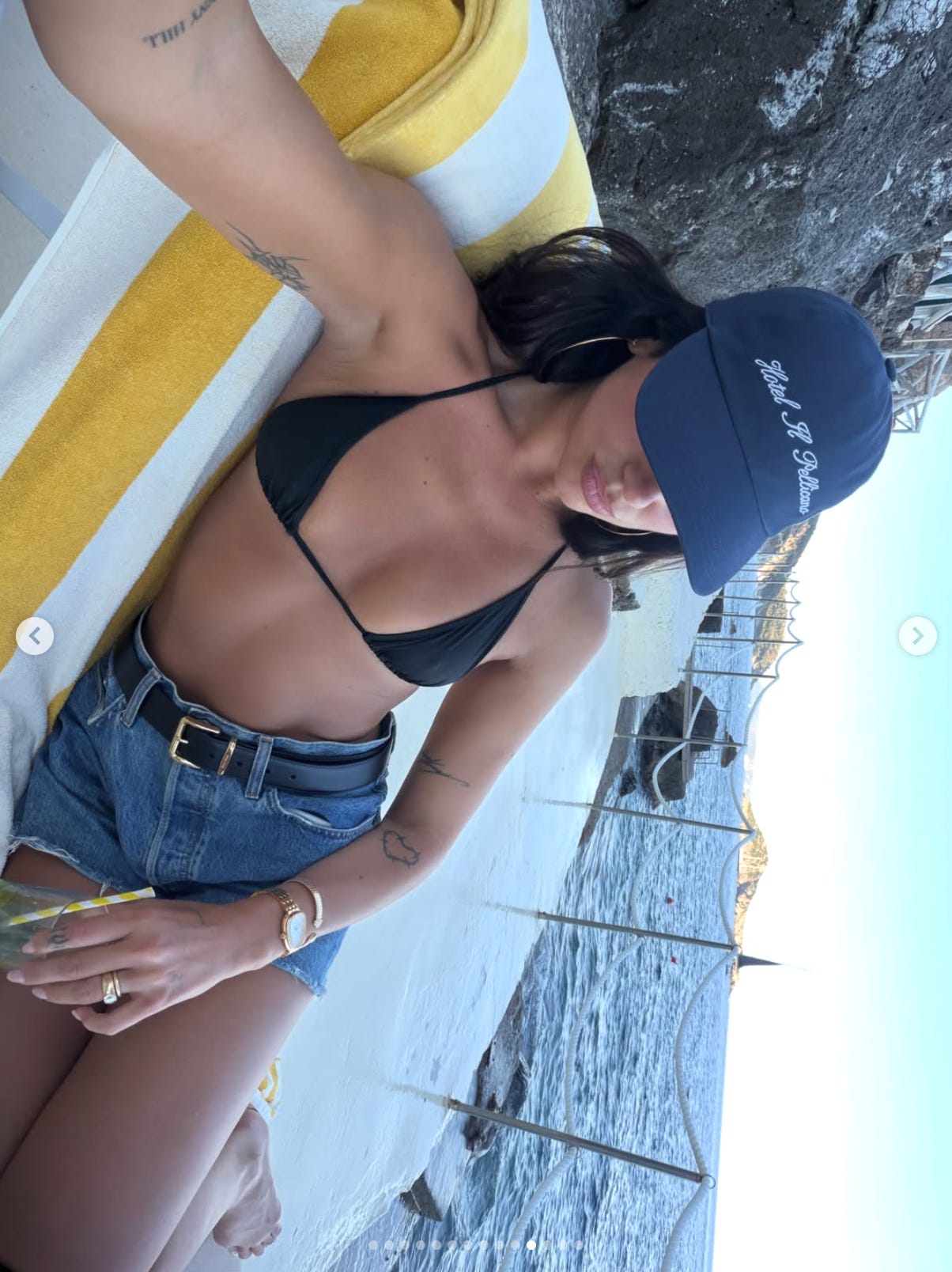
Layer social media on top, and the impact compounds exponentially. One proof point from last week: Dua Lipa posted a honeymoon carousel from Hotel Il Pellicano in Porto Ercole, captioned simply “heaven on earth.” One frame: Lipa on a striped beach towel in a navy cap embroidered with the hotel’s name. The post pulled 3.2 million likes within hours. No agency briefed that placement. No media plan bought that reach. A well-made hat, worn by someone with an audience, did what an entire quarter of paid social couldn’t.
Beyond the Drop
Executed well, merchandise feeds the rest of the media ecosystem instead of sitting apart from it. A beautifully made product is a native visual asset, something to shoot for a reel or a newsletter that isn’t another photo of an empty room or a lobby at golden hour. The content creation works both ways. That same object shows up organically in a guest’s own vacation photos, and later, in the version of their life they post from home.
Merch also complements the experiential marketing approach every luxury brand is leaning into right now. A pop-up or an activation lives and dies in the room unless something travels beyond it. Branded product, whether sold or gifted, is what carries the moment past the event recap post. The guest becomes the marketing: stories, reels, and outfit posts generating reach long after the installation comes down.
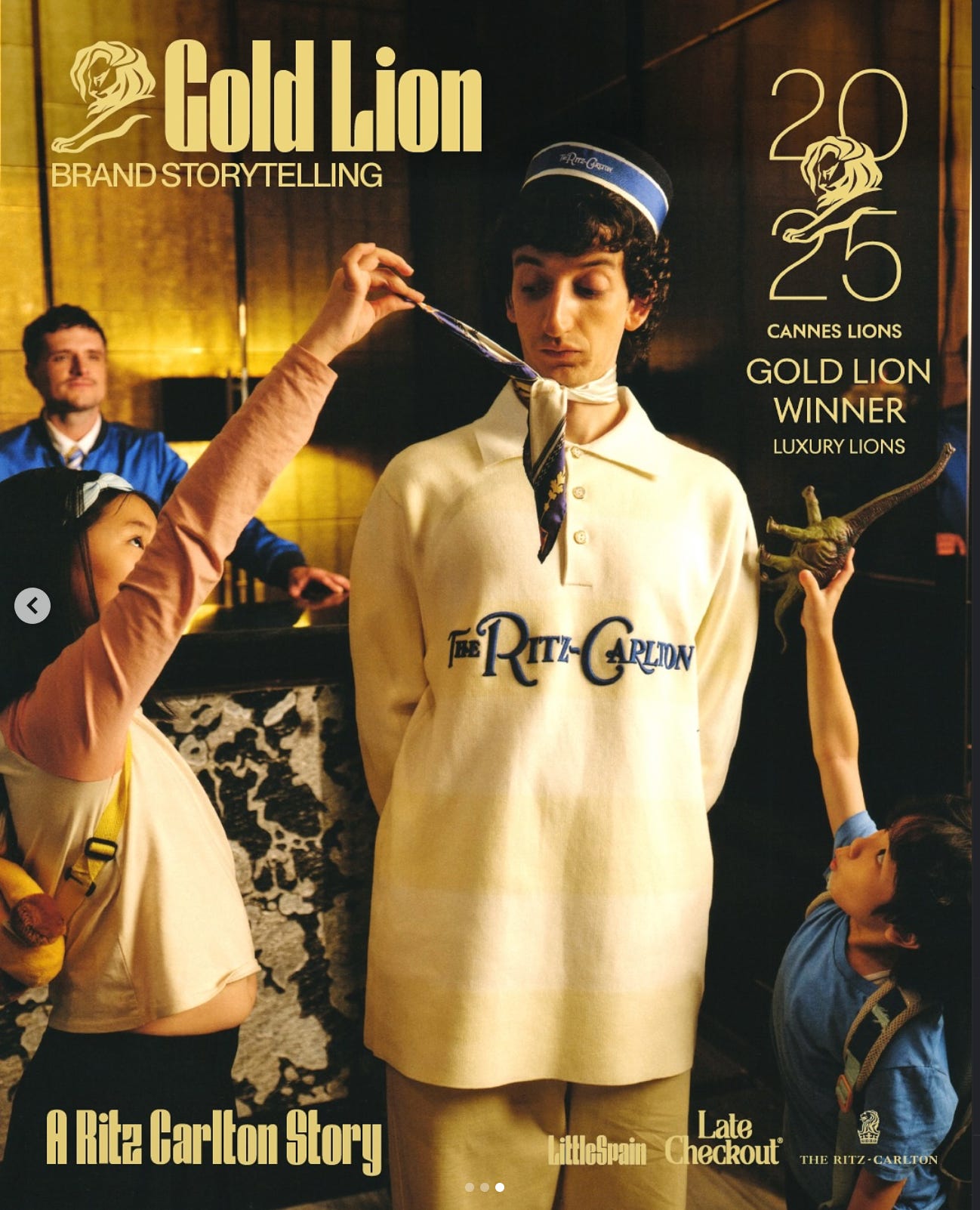
The strongest recent examples are full campaigns. Late Checkout has built its entire reputation on this: a capsule with a story, a film, and a real budget behind it. Their collaboration with The Ritz-Carlton is the clearest case of the loop working as designed. The product creates a content moment. The content drives sales. Limited runs create scarcity. Scarcity creates bragging rights, which creates more organic sharing, which feeds the next cycle.
The first campaign earned trade coverage on launch, then a Gold Cannes Lion, the first ever awarded to a luxury hospitality brand, then Platinum and Best of Show at this year’s HSMAI Adrian Awards. Two award seasons of media, not to mention millions of impressions and thousands of shares. In this category, a second chapter is earned, and this one arrived with a bigger footprint: an expansion into loungewear, kidswear, and home pieces, pop-ups at 22 hotels worldwide, and activations still running into 2026.
Collaborations also mean shared audiences and shared digital real estate, a second brand’s followers introduced to yours for the cost of the partnership rather than the cost of the media. As covered in the last piece in this series, that’s often exactly the borrowed edge, youth, novelty, cultural currency, that a legacy brand can’t manufacture on its own.
The Aspirational Non-Guest
Retail also unlocks an audience beyond current or potential guests. The most interesting buyer, at least to brands thinking about real longevity, is the person unlikely to book, at least not right now, who wants the identity anyway and is willing to pay for it. That’s a new revenue line with no incremental room cost to service it, and often the fastest way to bring a younger consumer into the brand’s orbit years before they can afford to stay.
Luxury retail has run this exact strategy for decades: an accessible entry price point, usually in beauty, for someone aspiring to the main product. The Chanel lipstick that satisfies the itch for the maxi flap bag. A buyer engaging with your brand at whatever price point they can currently reach is demonstrating the most durable form of loyalty there is, the kind that arrives before the ability to pay for the full product.
Data You Own, Not Rent
This last consideration is the least sexy of the group, but as a marketer I would be remiss not to raise it, because it may be the most critical one to the long-term success of your digital marketing operation.
Third-party cookies are on their way to extinction, and even where they survive, they’re irrelevant when the booking happens on an OTA, which, unfortunately, is where a large share of hotel bookings take place today. That’s a bigger topic for another time. The point here is that the value of an e-commerce storefront extends beyond the financial transaction to the data transaction that happens alongside it. When CRM and marketing teams operate seamlessly, every purchase welcomes a new brand ambassador into the ecosystem, enabling marketers to nurture and build audiences the brand owns outright rather than renting them from someone else’s platform. Beyond that single customer capture, the data becomes raw material for lookalike audiences built on verified, high-intent, affluent buyers.
Today, most hospitality brands still lean on transactional OTAs, rented social reach, or borrowed equity from influencers, rather than owning the data, the subscribers and the customer relationships. Merchandise, sold directly, builds the asset that actually compounds: a list of people who have already proven, with a purchase, that they want in.
The Closed Loop
None of this argues for choosing merch over digital media. Digital still scales awareness and captures the transaction at the moment of intent. What merch does is different: once a guest, or even an aspiring one, enters the ecosystem, the brand’s visual language becomes part of their daily life, and by extension, everyone who enters it.
A paid impression disappears the second the budget stops. Merch generates on its own schedule: a cap gifted at check-in and posted to 88 million people before checkout, a robe that settles into someone’s home and stays in frame for years. The property pays for the product once. The media keeps running. That is the most efficient channel most hotels aren’t yet operating as one.
Brilliant notion about merchandising becoming a media vehicle! Turning hotel guests into walking advertisement is the nexus of luxury hotels’ innovation. I wonder if other types of collaboration could be similarly successful? For example, could culinary partnerships act like merchandising? When renowned chefs align with the leading hotel brands, do they transfer their prestige and audience to those hotels? Does such cross-branding convert culinary talent into a tangible lifestyle product that attracts high-value guests?
I was fortunate enough to “consume” the luxury hotel brands through an extravagant breakfast at The Pulitzer Hotel in Amsterdam and the most elegant dining experience at the W hotel in St. Petersburg, Russia. Their chic atmosphere and exceptional menus satisfy their guests’ desires for unique, status-driven, unforgettable world-class experiences.
I cannot wait to read part 4 of the mini-series unveiling the topic of hotel merchandising in a thought-provoking manner.